What is an Apexo root elevator?
It is a slender, hand-held dental elevator, often called a root tip pick or apical elevator, used as a lever to loosen and lift retained roots and root tips from the socket.

Apexo root elevators in the 301, 302 and 303 patterns: slim, fine-bladed elevators for loosening and lifting retained roots and root tips. Supplied straight and angled, with blade width, tip, handle and finish agreed against your reference piece, for distributors, importers and private-label buyers.
B2B · OEM · PRIVATE LABEL · CUSTOM PACKAGING
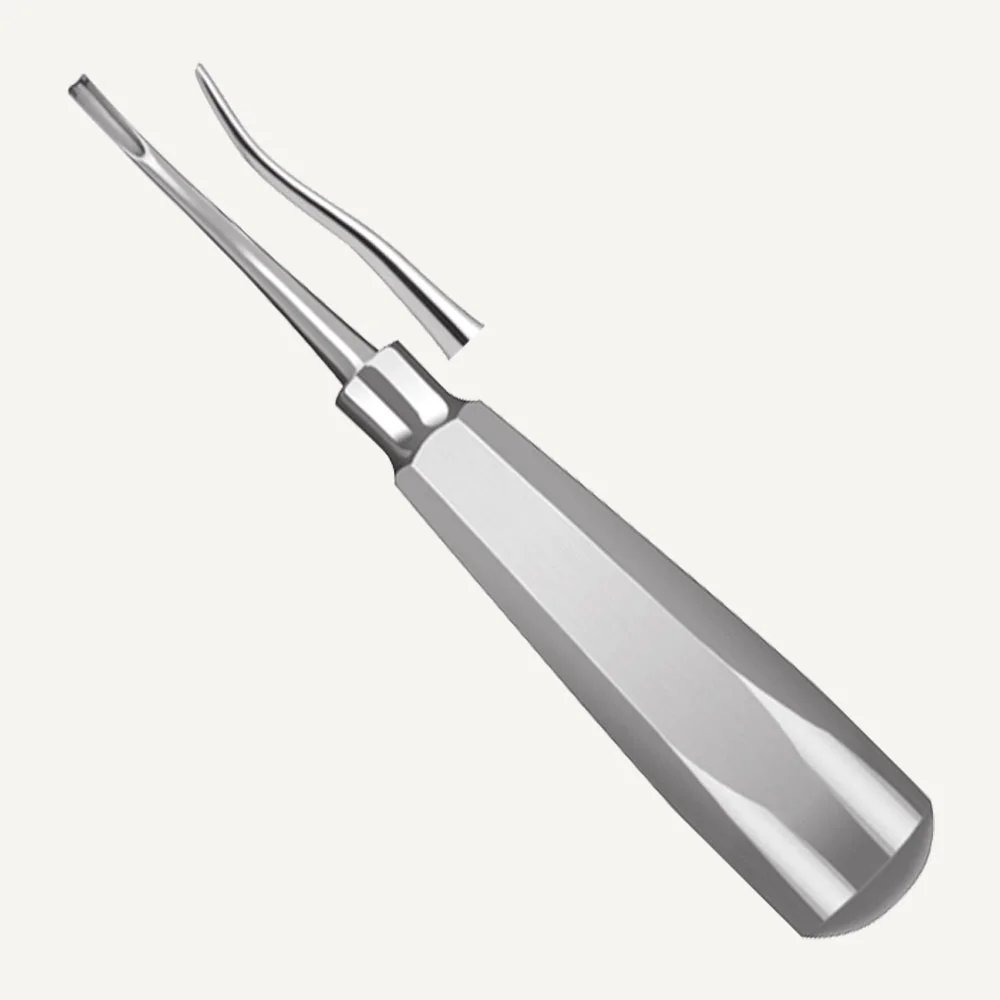
An Apexo elevator is a slender dental elevator, often called a root tip pick or apical elevator. It works as a small lever: the fine blade is slid between the root and the socket wall to loosen a retained root or root tip and lift it out. In the usual catalogue sequence the 301 has a straight blade, and the 302 and 303 are angled versions that let the tip reach other sides of a root.
Blade width is the figure that varies most. Published catalogues list the 301 at about 2.5 mm at some makers and about 3.0 mm at others, with a narrower modified 301 near 2.0 mm for children and veterinary work, and the 303 up to about 3.3 mm. Because the same number can mean a different width, we confirm blade width, bend and handle from your drawing or reference piece. Larger elevators are covered on the straight root elevator and Cryer root elevator pages.
Confirmed against your approved drawing or sample before production.
| Product | Apexo root elevator |
|---|---|
| Also listed as | Apexo elevator, root tip elevator, apical root elevator, root tip pick |
| Patterns | Fig. 301 (straight); Fig. 302 and 303 (angled); modified small 301 by reference |
| Application | Loosening and lifting retained roots and root tips |
| Configuration | Single-ended, unless another form is specified |
| Blade width | Commonly listed from about 2.0 to 3.3 mm; confirmed from reference |
| Blade tip | Plain or serrated |
| Handle | Thumb grip, power grip or plain; confirmed per order |
| Overall length | Confirmed from reference piece |
| Material | Stainless steel; grade confirmed in specification |
| Finish | To be agreed, for example satin or polished |
| Reuse | Reusable instrument; cleaning and sterilisation follow the user's validated procedure |
| Packaging | Bulk, standard or buyer-branded |
| Marking | Logo or reference marking by agreement |
| Supply condition | Sterile or non-sterile, as agreed in the quotation |
The pattern number sets the shape of the blade, and the blade width sets how fine the instrument is. Use the table as a starting point for your enquiry.
Include these points in an enquiry or sample approval request:
| Pattern | Blade form | Confirm |
|---|---|---|
| Apexo 301 | Straight | Blade width, plain or serrated |
| Apexo 302 | Angled | Bend direction, blade width |
| Apexo 303 | Angled (back-action bend listed) | Bend, blade width |
| Modified small 301 | Straight, narrower blade for children and veterinary work | Blade width |
The fine blade is used to get at the apical part of a root that has fractured and stayed in the socket.
Angled patterns reach the side of a fragment that a straight blade cannot, so it can be loosened and lifted.
A narrower modified 301 suits small mouths. See also our veterinary instruments.
Both are dental elevators used as levers in extraction. They differ in blade size and in the job they are chosen for.
| Point | Apexo elevator | Standard straight elevator |
|---|---|---|
| Blade | Slender and fine, commonly about 2.0 to 3.3 mm | Wider blade |
| Typical job | Root tips and fragments deep in the socket | Luxating the tooth |
| Patterns | 301 straight; 302 and 303 angled | Many sizes of straight blade |
| To specify | Pattern number, blade width, tip, handle | Blade width, handle, length |
Widths and lengths vary by maker. Use the approved drawing or sample as the procurement reference.
Iron Art makes and supplies dental and surgical instruments for buyers who want a defined specification, a sample to approve and repeatable supply. See our OEM and private-label services for how programmes are set up.
Send the pattern numbers you use, a drawing or a reference elevator, and the quantities you expect to order. We review it against your requirements, confirm blade width, handle, finish and packaging, and agree a sample before production begins.
Whichever supplier you use, these are the points to inspect when a sample arrives.
A straightforward route for buyers sourcing Apexo elevators in volume.
Pattern numbers, blade width, tip, handle, quantities and packaging.
Specification confirmed in writing, with any OEM or marking options priced.
Inspect a sample against your reference before production is released.
Reorders follow the approved specification, including private-label packs.
Short answers on patterns, blade widths and supply.
It is a slender, hand-held dental elevator, often called a root tip pick or apical elevator, used as a lever to loosen and lift retained roots and root tips from the socket.
They are catalogue pattern numbers. The 301 has a straight blade, while the 302 and 303 are angled versions, so the tip can reach different sides of a root. Blade width and handle still differ between makers.
Published catalogues list widths from about 2.0 mm for a small modified 301 up to roughly 3.3 mm, with 2.5 mm common for the 301. The same number can carry a different width at another maker, so we confirm width from your reference.
A standard straight elevator has a wider blade and is used to luxate the tooth. An Apexo elevator is narrower and finer, and is used mainly to get at root tips and fragments deep in the socket.
Both are listed in the market. A serrated tip gives extra grip on the root surface, and a plain tip is smoother. Tell us which you use and we will match it.
Yes. Catalogues list a modified, narrower 301, around 2.0 mm wide, for children and veterinary work. A custom width can be specified. Our veterinary range is on the veterinary instruments page.
Stainless steel is the standard option, with the grade confirmed in the agreed specification. Elevators are reusable instruments, and cleaning and sterilisation follow the user's own validated procedure.
Yes. Marking, handle style and packaging can be agreed for private-label programmes, and quantities are quoted per programme.
List the pattern numbers (301, 302, 303), blade width, plain or serrated tip, handle style, overall length, material and finish, quantity, packaging and marking. A photograph, drawing or current elevator speeds this up.
Send the pattern numbers, blade width, quantities and packaging requirements. A photograph, drawing or your current elevator will speed things up.