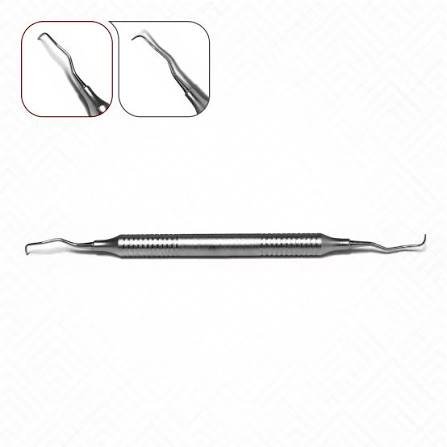
What is a Gracey curette?
A Gracey curette is an area-specific periodontal hand instrument used to remove calculus from crown and root surfaces and for root planing. Each blade is designed to adapt to a particular tooth surface, and only one cutting edge on each blade is used.
What is the difference between a Gracey curette and a universal curette?
A Gracey curette has its blade face offset at about 70 degrees to the lower shank and a single cutting edge, and each numbered pattern is made for a specific area. A universal curette has the blade at 90 degrees to the lower shank with two cutting edges, so one instrument can be adapted to most tooth surfaces.
Which Gracey curette is used for which area?
In the standard numbering, 1/2 and 3/4 are for anterior teeth, 5/6 for anterior teeth and premolars, 7/8 and 9/10 for posterior facial and lingual surfaces, 11/12 and 15/16 for posterior mesial surfaces, and 13/14 and 17/18 for posterior distal surfaces. Final selection follows clinical technique.
Why do Gracey curettes have two numbers, such as 7/8?
Gracey curettes are usually double-ended. The two numbers refer to the two working ends, which are mirror-image pairs set on a single handle, one for each side of the tooth surface.
What is a Gracey 5/6 curette used for?
Gracey 5/6 is the pattern for anterior teeth and premolars. When you quote, confirm blade length, shank length and handle against your reference.
What are Gracey 7/8 and 9/10 curettes used for?
Gracey 7/8 and 9/10 are the patterns for the facial and lingual surfaces of posterior teeth. Clinical selection follows technique and the surface being treated.
What are Gracey 11/12, 13/14, 15/16 and 17/18 used for?
11/12 and 15/16 are for the mesial surfaces of posterior teeth. 13/14 and 17/18 are for the distal surfaces of posterior teeth. The 15/16 and 17/18 patterns are used alongside 11/12 and 13/14 for the same surfaces.
Do Gracey curettes come in extended-shank and mini-blade versions?
Many catalogs list variants of the standard Gracey patterns. Extended-shank versions have a longer terminal shank to reach deeper pockets, and mini-blade versions have a shorter blade for narrow pockets, furcations and small roots. If you need a variant, state it and send a drawing or sample.
What material are Gracey curettes made from, and are they reusable?
Stainless steel is the standard option, with the exact grade, hardness and finish confirmed in the agreed specification. Gracey curettes are reusable hand instruments, and cleaning, sterilization and sharpening follow the buyer's own validated routine.
Do you supply OEM, private-label and bulk Gracey curettes?
Yes. Logo marking, reference numbers and packaging can be agreed for private-label programs, and OEM work follows your drawing or approved sample. Quantities are discussed per program.