What is a dental excavator?
It is a hand-held manual dental instrument used to cut, scrape and remove carious dentine from a decayed tooth. It is usually double-ended, with a central handle and small, sharp, spoon-, scoop- or spatula-shaped blades.

Double-ended spoon excavators for removing carious dentine and cleaning cavities. Supplied in the common pattern numbers, with spoon diameter, shank, handle and finish agreed against your reference instrument, for distributors, importers and private-label buyers.
B2B · OEM · PRIVATE LABEL · BULK DENTAL INSTRUMENTS
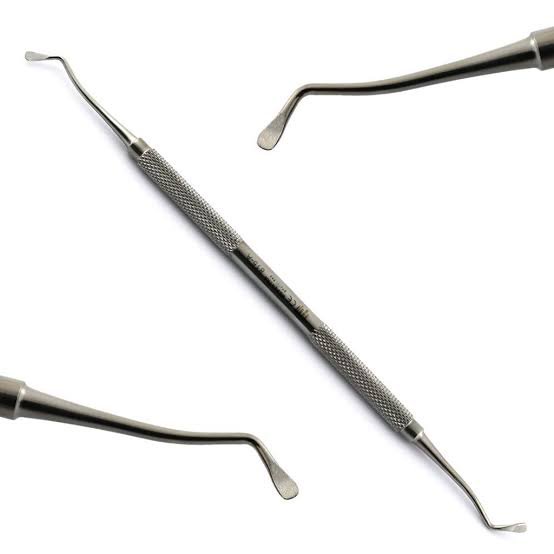
A dental excavator is a hand-held manual instrument for cutting, scraping and removing carious dentine from a decayed tooth. It is usually double-ended, with a central handle and a small, sharp, spoon-, scoop- or spatula-shaped blade at each end. Clinicians use it to clear softened dentine, clean out a cavity and remove temporary filling material before the restoration is placed.
Excavators are sold by pattern number, and the practical difference between patterns is the spoon diameter and the angle of the shank. Published catalogues list spoons from about 1.0 mm to 2.5 mm, and the same number can carry a slightly different diameter at another maker. We therefore confirm spoon diameter, shank and handle from your drawing or reference piece. For the other end of the operative set, see our composite filling instrument and ball burnisher.
Confirmed against your approved drawing or sample before production.
| Product | Dental excavator |
|---|---|
| Also listed as | Spoon excavator, double-ended spoon excavator, operative excavator |
| Application | Removing carious dentine, cleaning cavities, removing temporary filling material |
| Pattern numbers | 5/6, 11/12, 14, 17, 18, 19, 31/32; European 63/64, 65/66, 125/126, 127/128, 129/130 |
| Spoon diameter | Commonly listed from about 1.0 to 2.5 mm; confirmed from reference |
| Working end | Spoon-, scoop- or spatula-shaped with a sharpened edge |
| Configuration | Double-ended; single-ended on request |
| Shank | Standard or long shank; angle confirmed per pattern |
| Handle | Plain round, hollow or satin finish; diameter confirmed per order |
| Overall length | Confirmed from reference piece |
| Material | Stainless steel; grade confirmed in specification |
| Finish | To be agreed, for example satin or polished |
| Reuse | Reusable instrument; cleaning and sterilisation follow the user's validated procedure |
| Packaging | Bulk, standard or buyer-branded |
| Marking | Logo or reference marking by agreement |
| Supply condition | Non-sterile or sterile, as agreed in the quotation |
Pick the spoon size first, then the shank and handle. The figures below are those listed in one published catalogue, so use them as a starting point for your enquiry.
Include these points in an enquiry or sample approval request:
| Pattern | Listed spoon | Note |
|---|---|---|
| 17 | about 1.2 mm | Small spoon |
| 18 | about 1.5 mm | Commonly listed as medium |
| 19 | about 2.0 mm | Commonly listed as large |
| 5 / 6 | Anterior spoons | Angled shanks, listed at 50° and 65° |
| 63/64, 65/66 | about 1.5 mm, 1.0 mm | European numbering |
| 125/126, 127/128, 129/130 | about 2.5, 2.0, 1.8 mm | European numbering |
| 31 / 32 / 33 | Spoon on a long shank | Deeper access |
The sharpened spoon scrapes away softened dentine while the clinician works toward sound tooth structure.
Used to clear debris from a prepared cavity and to remove temporary filling material before the restoration.
Supplied alongside explorers, carvers and filling instruments in restorative sets.
All three have a scraping working end, but they are made for different tissue and different jobs.
| Point | Dental excavator | Periodontal curette | Bone curette |
|---|---|---|---|
| Used on | Carious dentine in a cavity | Tooth and root surfaces | Bone and soft tissue in a socket or cavity |
| Working end | Small sharp spoon, about 1.0 to 2.5 mm | Curved blade, for example Gracey or universal | Larger spoon, for example Volkmann pattern |
| Typical setting | Operative and restorative | Periodontal scaling and root planing | Oral and general surgery |
Sizes and patterns vary by maker. Use the approved drawing or sample as the procurement reference.
Iron Art makes and supplies dental and surgical instruments for buyers who want a defined specification, a sample to approve and repeatable supply. See our OEM and private-label services for how programmes are set up.
Send the pattern numbers you use, a drawing or a reference excavator, and the quantities you expect to order. We review it against your requirements, confirm spoon diameters, shank, handle, finish and packaging, and agree a sample before production begins.
Whichever supplier you use, these are the points to inspect when a sample arrives.
A straightforward route for buyers sourcing dental excavators in volume.
Pattern numbers, spoon diameters, handle, quantities and packaging.
Specification confirmed in writing, with any OEM or marking options priced.
Inspect a sample against your reference before production is released.
Reorders follow the approved specification, including private-label packs.
Short answers on patterns, spoon sizes and supply.
It is a hand-held manual dental instrument used to cut, scrape and remove carious dentine from a decayed tooth. It is usually double-ended, with a central handle and small, sharp, spoon-, scoop- or spatula-shaped blades.
It removes softened carious dentine and debris during cavity preparation, and it is also used to clean out a cavity and to remove temporary filling material before restorative work.
They are catalogue pattern numbers. Each number identifies a spoon size and shank form. In common listings the 17, 18 and 19 are small, medium and large spoons, and the 5 and 6 are angled anterior spoons. Numbers differ between makers, so match by drawing or sample.
Published catalogues list spoon diameters from about 1.0 mm to 2.5 mm. The same number can carry a different diameter at another maker, so we confirm the diameter in millimetres from your reference.
Two working ends on one handle give two spoon sizes or two angles in one instrument, so the clinician does not need to change instruments for a larger or smaller cavity.
A spoon excavator is used on carious dentine during cavity preparation. A periodontal curette, such as a Gracey or universal curette, is used for scaling and root planing, and a bone curette is a larger surgical spoon for bone work.
Stainless steel is the standard option, with the grade confirmed in the agreed specification. Handles are listed as plain round, hollow and satin-finish styles, and long-shank patterns are made for deeper access.
Stainless steel excavators are reusable instruments, and cleaning and sterilisation follow the user's own validated procedure. Single-use excavators exist in the market but are a different product.
Yes. Pattern numbers, handle style, marking and packaging can be agreed for private-label programmes, and quantities are quoted per programme. Send the pattern numbers, spoon diameters, handle style, finish, quantity and packaging, with a photograph or sample if you have one.
For placing and shaping restorative material.
View instrument →Send the pattern numbers, spoon diameters, quantities and packaging requirements. A photograph, drawing or your current excavator will speed things up.